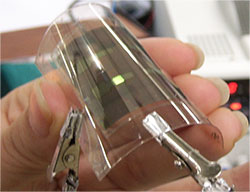
 Plastic materials are inherently much more permeable to gases and moisture compared to metal or glass. Thin oxide films coated onto plastic films have defects such as pinholes, cracks and grain boundaries.TBF have developed an innovative approach to resolve the ‘pore effect’ due to the thin oxide film defects by plugging the defects with nanoparticles. Moreover, these nanoparticles serve a dual function: they not only seal the defects but can also actively react with and retain moisture and oxygen.
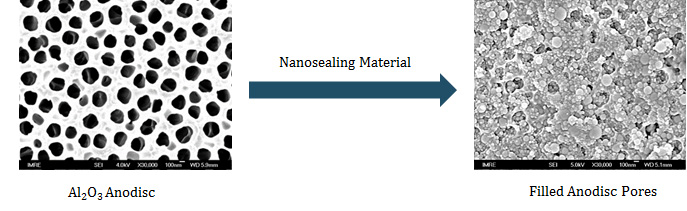 TBF has novel encapsulated reactive nanoparticles that are capable of plugging the defects of porous barrier films. These nanosealing materials are a key component for TBF's high barrier films.
The TBF nanosealing materials can be tuned for various applications, and various functions such as UV blocking, weatherability, anti-reflection can be incorporated.
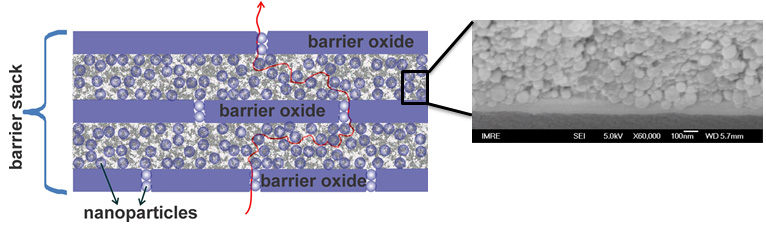 TBF’s core technology is its nanosealing material and barrier stack technology deposited on flexible substrates. Defects such as pinholes, cracks and grain boundaries are common in thin oxide barrier films when fabricated onto plastic substrates. TBF has taken an innovative approach to resolve the ‘pore effect’ by literally plugging the defects in the barrier oxide films using nanoparticles. This reduces the number of barrier layers needed in the construction of the barrier film. TBF’s barrier stack consists of barrier oxide layers and nanosealing layers. The nanoparticles in used in the barrier film have a dual function ‐ not only sealing the defects but also actively reacting with and retaining moisture and oxygen.
Breakthrough moisture barrier performance of better than 10‐6 g/m2.day, or one millionth of a gram per square meter per day has been obtained. The barrier film also has a lag time of more than 2,300 hours at 60°C and 90% RH (i.e. the time required for moisture to pass through the barrier film under those conditions).
We provide various ranges of flexible barrier films from 10-1 to 10-6 g/m2.day
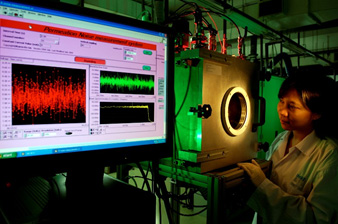
The high speed manufacturing technology can significantly reduce the cost and therefore, TBF can cover the low-end applications and enhance the lifetime of the products and devices at lower cost.
TBF has several IPs relating to device encapsulation which can be adapted to specific applications and requirements.